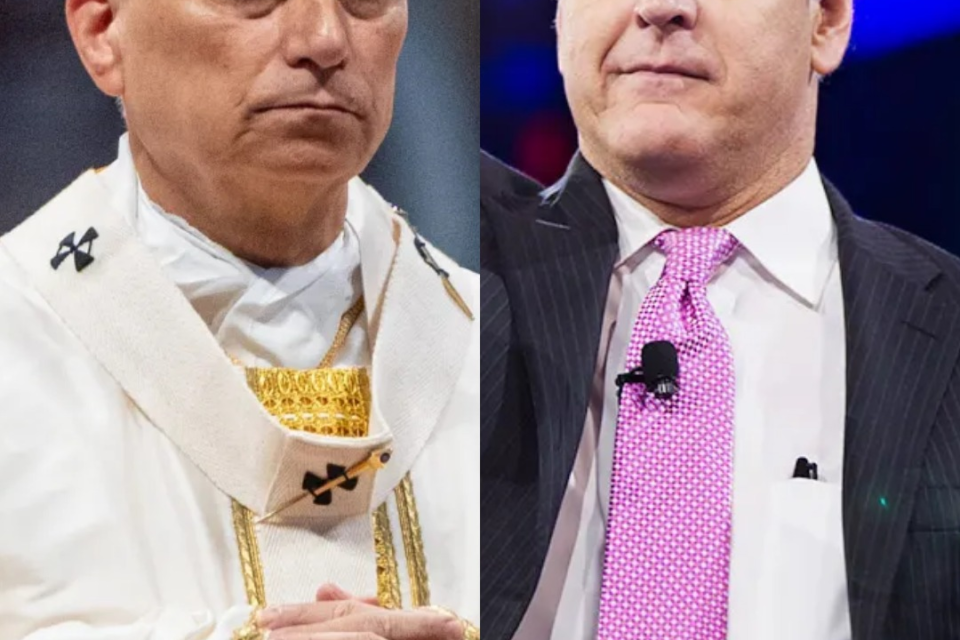
In an era where headlines travel faster than facts and commentary often shapes perception before truth can catch up, the intersection of politics, media, and religion has become one of the most volatile arenas in public discourse. Recently, renewed attention has been drawn to outspoken criticism directed at the Vatican by prominent media figures, including Sean Hannity. While specific quotes and claims circulating online remain difficult to verify in their exact form, the broader narrative they represent is unmistakable: a deepening divide over who holds moral authority in an increasingly polarized world.
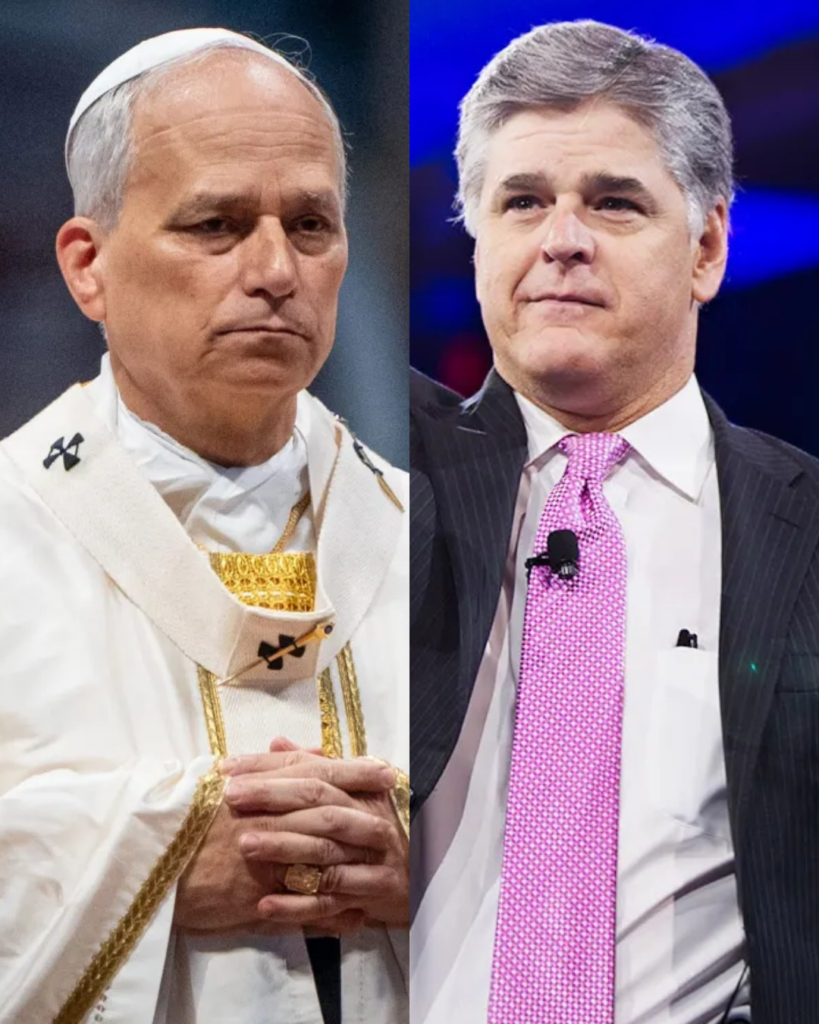
At the center of this conversation stands Pope Francis, a leader whose tenure has been marked by efforts to modernize the Church’s tone while maintaining its doctrinal foundation. His approach has earned both admiration and criticism, particularly from voices that view his messaging as a departure from traditional interpretations of scripture.
This clash is not simply about theology. It is about influence—about whose voice resonates most powerfully in shaping public values, and about how institutions adapt (or resist adaptation) in a rapidly changing cultural landscape.
The Rise of Media as Moral Commentary
Historically, religious institutions like the Vatican held a near-monopoly on moral guidance for millions of believers. For centuries, the Church’s teachings provided a framework for understanding right and wrong, shaping societies across continents.
But the rise of modern media has fundamentally altered that dynamic.
Today, figures like Sean Hannity command audiences that rival—or in some cases exceed—the reach of traditional religious platforms. With nightly broadcasts, social media amplification, and loyal followings, such commentators have become influential voices not just in politics, but in moral and cultural debates.
This shift has created a new kind of competition: one not formally declared, but deeply felt. On one side stand institutions rooted in centuries of tradition. On the other stand media personalities who interpret current events through ideological lenses, often framing their perspectives as reflections of deeper truths.
Pope Francis and a Changing Church
Since assuming the papacy in 2013, Pope Francis has sought to emphasize compassion, inclusivity, and dialogue. His focus on issues such as climate change, economic inequality, and the treatment of marginalized communities has resonated with many, particularly younger generations.
However, this approach has also sparked criticism from those who believe the Church should prioritize doctrinal clarity over social engagement. For critics, the concern is not merely about specific policies or statements, but about the broader direction of the Church.
Is it adapting to remain relevant, or drifting away from its core teachings?
That question lies at the heart of much of the commentary directed toward the Vatican in recent years.
The Power of Narrative in a Divided World
In today’s media environment, narratives often carry more weight than nuanced analysis. A single phrase—especially one framed as a bold or controversial declaration—can dominate headlines and shape public perception.
This is particularly true when it comes to conflicts between high-profile figures and institutions. The idea of a media personality openly challenging the Pope is inherently dramatic, tapping into themes of authority, rebellion, and ideological struggle.
But such narratives can also oversimplify complex realities.
Religious doctrine is rarely as binary as “right” or “wrong.” Political perspectives are shaped by a wide range of factors, from personal beliefs to audience expectations. And media commentary, by its nature, often prioritizes clarity and impact over theological depth.
As a result, what appears to be a direct confrontation may, in reality, be a reflection of broader societal tensions rather than a single, clearly defined dispute.
Faith, Interpretation, and Authority
One of the most enduring questions in religion is who has the authority to interpret sacred texts.
For the Catholic Church, that authority is structured and hierarchical, rooted in centuries of tradition and theological scholarship. The Pope, along with other Church leaders, plays a central role in guiding interpretation and teaching.
In contrast, modern media operates on a different model—one that is decentralized, immediate, and often driven by audience engagement. Commentators interpret events in real time, offering perspectives that may align with or challenge established institutions.
When these two systems intersect, friction is almost inevitable.
Critics who accuse the Church of straying from “true” teachings are, in essence, asserting an alternative interpretation of those teachings. Supporters of the Church, meanwhile, emphasize the importance of continuity, context, and institutional authority.
This tension is not new. It echoes debates that have taken place throughout history, from the Reformation to modern theological disputes. What is new is the speed and scale at which these debates now unfold.
The Role of Audience and Identity
Another key factor in this dynamic is the role of the audience.
Media figures like Sean Hannity do not speak into a vacuum. Their commentary is shaped by—and in turn shapes—the expectations and beliefs of their viewers. Similarly, religious leaders address communities with diverse perspectives, seeking to provide guidance that resonates across cultural and generational lines.
In a polarized environment, these audiences often interpret the same message in very different ways.
For some, criticism of the Vatican may be seen as a defense of traditional values. For others, it may appear as an unwarranted attack on a longstanding institution. The same statement can reinforce existing beliefs or provoke strong opposition, depending on who is listening.
This dynamic underscores a broader reality: that debates about faith and authority are also debates about identity.
Beyond Headlines: The Need for Context
In the rush to capture attention, it is easy for media coverage to prioritize conflict over context. Dramatic framing—phrases like “turning up the heat” or “showdown”—can make stories more compelling, but they can also obscure the underlying issues.
A more nuanced understanding requires looking beyond individual statements to the broader patterns they represent.
Why do certain critiques resonate at this moment in time?
What concerns are driving both supporters and critics?
How are institutions adapting to changing expectations?
These questions are more difficult to answer, but they are essential for understanding the full picture.
A Reflection of Broader Cultural Shifts
Ultimately, the tension between media voices and religious institutions reflects deeper changes in society.
Authority is no longer centralized. Information flows freely across platforms. Individuals have unprecedented access to diverse perspectives, allowing them to form their own interpretations rather than relying solely on traditional sources.
This democratization of discourse has many benefits, but it also creates challenges. Without shared frameworks for understanding, disagreements can become more pronounced, and common ground can be harder to find.
In this context, conflicts between figures like Sean Hannity and institutions led by Pope Francis are not isolated events. They are part of a larger conversation about how societies define truth, authority, and meaning in the modern age.
Conclusion: More Than a Dispute
What may appear at first glance as a direct confrontation between a media personality and the Vatican is, in reality, something more complex.
It is a reflection of shifting power dynamics.
A debate over interpretation and tradition.
A manifestation of the broader tensions shaping today’s world.
As these conversations continue, one thing remains clear: the relationship between media, politics, and religion will remain a defining feature of public discourse.
And in that ongoing dialogue, the challenge is not simply to choose sides, but to seek understanding—recognizing that behind every headline lies a deeper story, one that cannot be reduced to a single quote or a single moment of controversy.
I think the Pope has the moral right to condemn war. The truth is when a country like Iran has been fighting us for 47 years. Needs to be captured and any weapons that present a threat should be taken. No nuclear weapons for Iran they can not be trusted.