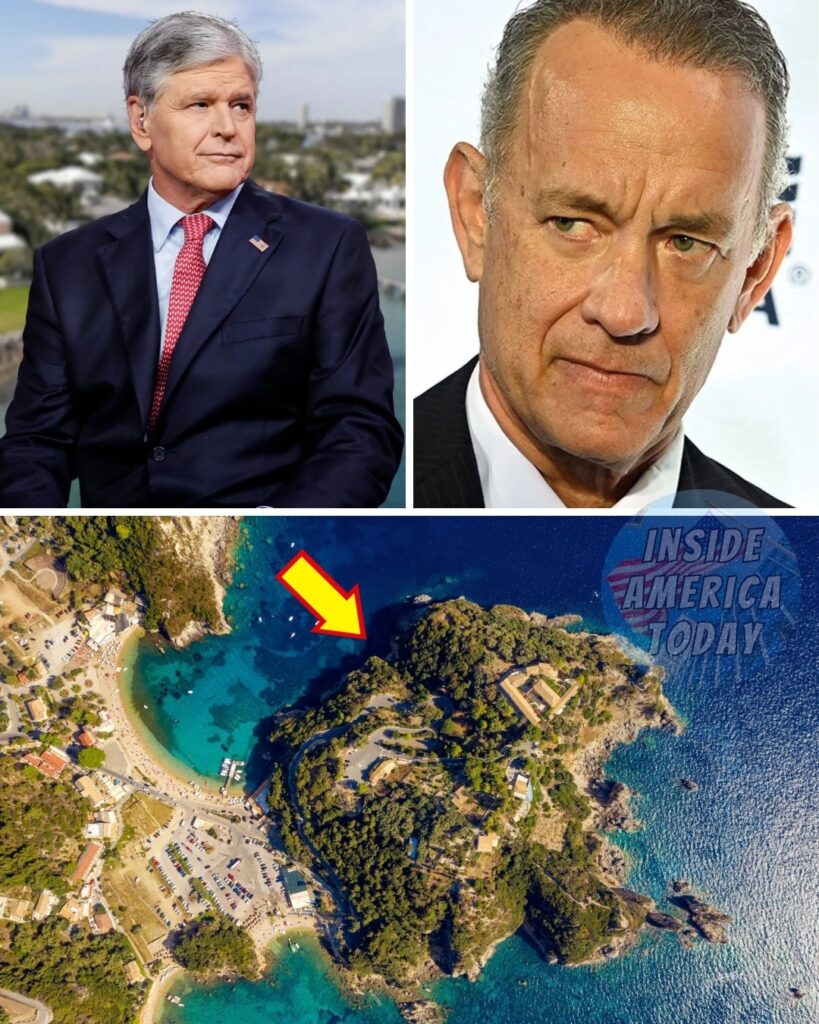
In the fast-moving world of digital media, it takes only minutes for a rumor to transform into what looks like a global headline. That’s exactly what’s happening with a viral claim now circulating across social platforms: that Sean Hannity allegedly told his audience he believes Tom Hanks is building a new “cabal island” following the death of Jeffrey Epstein.
The claim is explosive. It’s emotional. It’s designed to provoke a reaction.
But is it true?
A closer look reveals a very different story—one that says more about the internet than it does about the people involved.
The Claim That Sparked the Firestorm
According to widely shared posts, Hannity supposedly warned viewers that “these men were never going to stop” and claimed that powerful figures had relocated operations to a new, more secure island—allegedly owned by Tom Hanks near Greece.

The narrative goes further:
- The island is described as existing in a “jurisdictional gray zone” between Greece and Turkey
- It allegedly operates without permits or law enforcement oversight
- It is said to include a private airstrip
- And most dramatically, it is framed as a successor to Epstein’s infamous network
The timing is also presented as suspicious: Epstein’s death in 2019 followed shortly by Hanks reportedly purchasing property in the region.
Taken together, the story paints a chilling picture.
There’s just one problem.
There is no credible evidence supporting any of it.
No Record, No Proof, No Confirmation
Despite the claim being framed as a recent statement, there is no verified footage, transcript, or credible report confirming that Sean Hannity ever made these remarks.
Major media outlets have not covered the statement. No official clips from Fox News broadcasts support it. No reputable journalists have corroborated it.
In today’s media environment, a statement that serious—especially involving figures of that scale—would be immediately picked up, analyzed, and debated across mainstream platforms.
That hasn’t happened.
And that silence matters.
The Reality of Tom Hanks’ Presence in Greece
Part of the rumor’s appeal comes from a kernel of truth.
Tom Hanks and his wife, Rita Wilson, have long-standing ties to Greece. Wilson has Greek heritage, and the couple has spent significant time in the country. In fact, they were granted honorary Greek citizenship in 2020.
But claims that Hanks owns a secretive island operating outside legal oversight are not supported by any verified public records.
Greece maintains strict jurisdiction over its territory, including its islands. Property ownership, construction, and aviation activity are all regulated under national law.
The idea of a “no-law island” in that region is not just unlikely—it’s legally implausible.

Why the Story Feels Convincing
Even without evidence, the story has spread rapidly. That’s not an accident.
It taps into several powerful narrative elements:
1. Familiar Conspiracy Frameworks
The structure of the claim mirrors previous conspiracy theories involving elite networks, hidden locations, and secrecy. By referencing Epstein, it connects to a real and widely known scandal—making the leap to fiction feel smaller.
2. High-Profile Names
The involvement of Hannity and Hanks adds instant credibility and attention. One is a major political commentator, the other a globally respected actor. Combining them creates a sense of significance.
3. Geographic Mystery
An island between Greece and Turkey evokes a sense of distance and ambiguity. For many readers, it feels remote enough to be plausible, even if the legal reality says otherwise.
4. Emotional Language
Phrases like “they were never going to stop” and “more secure location” are designed to trigger fear and urgency—key ingredients for viral content.
The Role of Social Media Amplification
Once a story like this appears, it spreads through a predictable pattern:
- A post makes a dramatic claim
- Others copy and repost it
- Minor variations are added
- Engagement increases
- Algorithms push it further
Soon, repetition creates the illusion of confirmation.
But repetition is not evidence.
In many cases, these posts originate from pages that prioritize engagement over accuracy. The goal is not to inform—it’s to capture attention.
The Epstein Effect
Any story connected to Jeffrey Epstein carries immediate weight.
His case exposed real crimes, real victims, and real failures in accountability. Because of that, his name has become a powerful anchor in conspiracy narratives.
By linking a new claim to Epstein, even loosely, it gains emotional gravity.
But that also makes it easier for misinformation to spread—because people are already primed to believe something hidden or unresolved exists.
Separating Suspicion from Reality
It’s important to distinguish between:
- Asking questions
- And accepting claims without evidence
Skepticism can be healthy. But it needs to be grounded in verifiable facts.
In this case:
- There is no confirmed Hannity statement
- No verified island project
- No evidence connecting Tom Hanks to any illegal activity
- And no legal basis for the “jurisdiction-free zone” claim
Each part of the story collapses under scrutiny.
Why These Stories Keep Appearing
This isn’t a one-off incident.
Similar narratives have circulated for years, often involving different celebrities but following the same formula:
- A shocking claim
- A hidden location
- A connection to a known scandal
- And a sense of urgency
They persist because they work.
They generate clicks, shares, and emotional reactions. And in the attention economy, that’s often enough.
The Real Takeaway
The viral claim about Sean Hannity and Tom Hanks is not supported by credible evidence. It reflects a broader pattern of misinformation that blends real names with fictional narratives to create compelling—but misleading—stories.
That doesn’t mean people should ignore everything they see.
It means they should pause, verify, and question the source.
Because in a world where information moves instantly, the difference between truth and fiction often comes down to one simple step:
Checking before believing.
Final Word
If a claim of this magnitude were real, it wouldn’t live only on repost pages and viral captions.
It would be documented, investigated, and confirmed by multiple reliable sources.
Until that happens, this story belongs in a different category—not breaking news, but a case study in how quickly misinformation can spread when it’s packaged the right way.