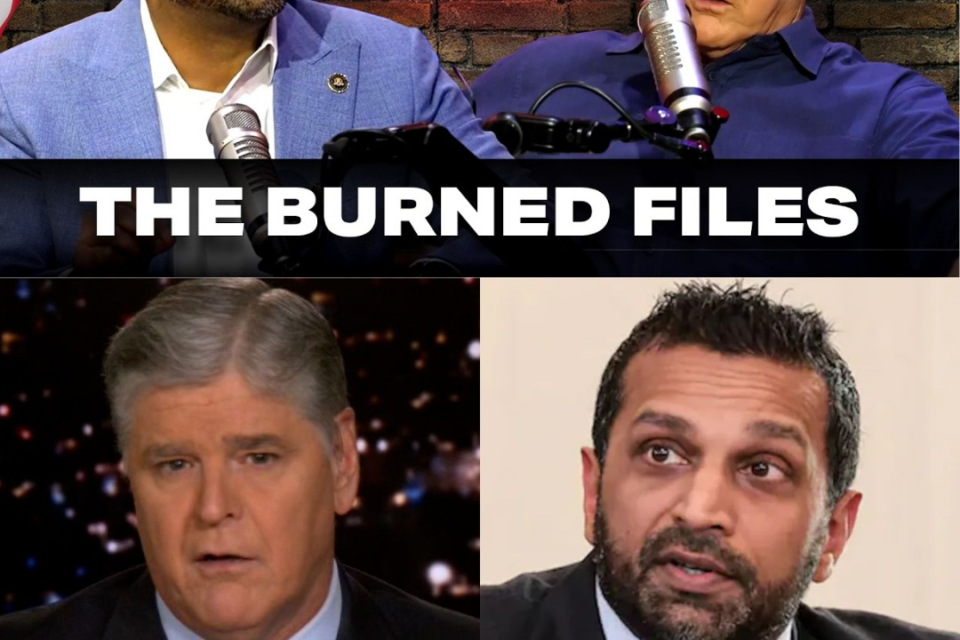
A fiery television interview between conservative host Sean Hannity and FBI Director Kash Patel has ignited intense debate across political media, law enforcement circles, and social platforms nationwide. What began as a routine primetime discussion quickly transformed into a dramatic and controversial examination of the future of the FBI, the legacy of past political investigations, and Patel’s claim that the Bureau is undergoing one of the largest internal transformations in modern American history.

During the interview, Patel painted a picture of an FBI in transition — an agency he says is being reshaped from the inside out. Hannity, known for his aggressive questioning style and longstanding criticism of federal law enforcement leadership, repeatedly pressed Patel for specifics about what exactly is happening behind closed doors at the Bureau. The answers stunned viewers.
Patel claimed the FBI has redirected hundreds of personnel out of Washington and into field operations across the country, describing the move as part of a broader effort to refocus the agency on violent crime, terrorism prevention, gang enforcement, and public safety rather than what he suggested had become politically driven investigations in previous years.
“We are returning the FBI to its core mission,” Patel said during the interview. “The American people deserve an FBI focused on protecting communities, stopping violent offenders, and preventing attacks — not chasing political narratives.”

The discussion immediately captured national attention because of Patel’s sweeping allegations regarding evidence and internal materials allegedly discovered inside FBI facilities. According to Patel, investigators recently uncovered storage rooms containing sealed records, computer drives, and boxes of materials tied to controversial past investigations. Though he stopped short of revealing detailed contents, he strongly implied the discoveries could be connected to politically explosive cases that have dominated American media and politics for years.
Hannity seized on the moment.
“So are you telling the American people there are records hidden inside the FBI that nobody accounted for?” Hannity asked.
Patel responded carefully but firmly, saying there are ongoing internal reviews examining “how evidence and investigative material were handled” under prior leadership structures. He framed the issue as part of what he called a broader “de-weaponization” process inside federal law enforcement.
The comments immediately triggered a firestorm online.
Supporters of Patel argued the revelations validate years of accusations that parts of the federal government operated without transparency or accountability. Critics, however, accused Patel of making dramatic claims without presenting verifiable public evidence.
Political commentators across both sides of the ideological spectrum quickly weighed in. Conservative voices praised Patel for confronting what they describe as institutional corruption, while others warned the rhetoric risks undermining trust in federal agencies without sufficient proof.

But the interview did not stop there.
One of the most striking moments came when the conversation shifted toward artificial intelligence and national security. Patel claimed the FBI is increasingly relying on advanced AI-assisted systems to identify threats before they escalate into acts of violence.
According to Patel, the Bureau now processes massive amounts of threat data using AI-driven analytical tools capable of rapidly flagging patterns linked to school violence, gang coordination, extremist communications, and potential terror activity.
Hannity appeared particularly interested in reports that the technology had allegedly helped prevent mass casualty events.
Patel referenced incidents in North Carolina and New York in which federal authorities allegedly intervened after AI systems identified alarming behavioral indicators within incoming tips and digital communications.
“We are using technology to save lives,” Patel said. “If artificial intelligence can help stop a school shooting before it happens, we are going to use it responsibly and aggressively.”
The statement sparked another wave of debate.
Some viewers applauded the modernization efforts, arguing that law enforcement agencies must evolve alongside rapidly changing threats. Others raised concerns about surveillance, transparency, and the growing role of AI in government operations.
Civil liberties advocates questioned how such systems operate, what safeguards exist, and whether innocent individuals could be swept into investigations based on algorithmic analysis. Technology analysts also pointed out that little publicly available evidence has been released showing precisely how the AI systems function or how many threats were genuinely prevented.
Still, the message Patel wanted to send was unmistakable: the FBI, under his leadership, intends to become faster, more aggressive, and more technologically advanced.
The interview also focused heavily on violent crime and gang enforcement.
Patel claimed the Bureau has dramatically increased operations targeting organized street gangs and repeat violent offenders. He cited large-scale arrests, coordinated raids, and partnerships with local law enforcement agencies across multiple states.
According to Patel, thousands of violent criminals have been taken off the streets in recent months, while federal task forces have intensified efforts against gangs involved in drug trafficking, human trafficking, weapons distribution, and organized violence.
Hannity repeatedly framed these efforts as evidence that the FBI is “getting back to basics.”
For years, conservative media figures have argued that federal agencies became distracted by political controversies instead of focusing on traditional law enforcement priorities. Patel leaned heavily into that argument during the interview, presenting himself as a reformer determined to restore public confidence in the Bureau.
Another surprising topic involved federal operations in rural and Indigenous communities.
Patel briefly referenced specialized initiatives targeting violent crime networks operating in remote regions where law enforcement resources are often limited. He argued that certain communities have historically received insufficient federal protection and claimed new operational strategies are improving coordination between local authorities and federal agents.
Though details were limited, the remarks suggested the FBI is attempting to broaden its public image beyond high-profile political investigations and urban crime operations.
Yet despite Patel’s confident tone, controversy continues to surround his leadership.
Reports have emerged describing growing tensions inside the FBI, including allegations that employees were subjected to internal scrutiny aimed at identifying media leaks. Critics say such measures create a climate of fear within the Bureau. Supporters counter that unauthorized leaks have long damaged investigations and public trust.
Former intelligence officials and legal analysts remain divided over Patel’s approach. Some believe the reforms could genuinely streamline the Bureau and restore operational focus. Others fear the rhetoric surrounding “deep state” narratives and hidden evidence could further politicize federal law enforcement.
The broader political context surrounding the interview cannot be ignored.
The FBI has spent years at the center of America’s most divisive political battles — from investigations into election interference and classified documents to domestic extremism and January 6 prosecutions. Public trust in institutions has become increasingly fractured, with many Americans viewing federal agencies through intensely partisan lenses.
That reality made the Hannity-Patel interview more than just another cable news segment. For supporters, it represented a long-awaited reckoning inside a powerful institution. For critics, it raised concerns about sensationalism, political messaging, and the possibility that unverified allegations could inflame distrust even further.
Social media reactions exploded almost immediately after the broadcast.
Clips of Hannity aggressively questioning Patel spread rapidly across Facebook, X, YouTube, and TikTok. Supporters described the interview as “historic” and “the beginning of accountability.” Critics called it “political theater” designed to energize audiences already skeptical of federal institutions.
Meanwhile, independent analysts noted that many of Patel’s most explosive claims remain difficult to independently verify at this stage. Without public documentation or released investigative findings, much of the conversation remains rooted in allegations rather than confirmed conclusions.
Still, the political impact may already be significant.
The interview reinforced Patel’s image as one of the most controversial and closely watched figures in modern federal law enforcement. It also highlighted the growing overlap between politics, media, technology, and criminal justice in America’s increasingly polarized environment.
As debates continue over surveillance, institutional trust, violent crime, and government transparency, one thing is certain: the questions raised during Hannity’s interview are not going away anytime soon.
Whether Patel’s promised transformation of the FBI ultimately restores confidence or deepens division remains to be seen. But after this explosive televised exchange, Americans on all sides of the political spectrum are now watching the Bureau more closely than ever before.