Sean Hannity has once again placed America’s immigration crisis at the center of national debate after delivering a forceful monologue criticizing the border policies implemented under Joe Biden.
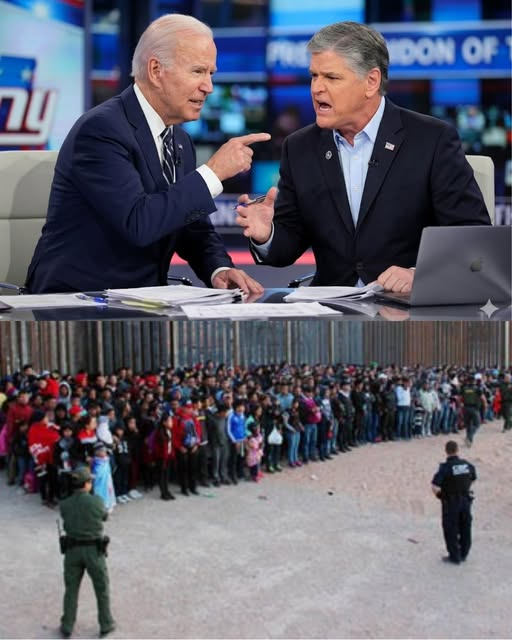
During his latest broadcast, Hannity argued that the recent surge in migrant crossings along the southern border is not simply the result of global instability or temporary migration trends, but rather the predictable outcome of deliberate policy shifts that, in his view, fundamentally changed how border enforcement operates in the United States.
The comments immediately reignited fierce political debate online and across cable news platforms, underscoring how immigration remains one of the most emotionally charged and politically divisive issues in modern American politics.
According to Hannity, the current situation represents more than a temporary strain on federal agencies.
He framed it as evidence of a broader breakdown in immigration enforcement strategy.
“This did not happen by accident,” Hannity told viewers. “You change enforcement priorities, you weaken deterrence, and eventually the system becomes overwhelmed.”

Throughout the segment, Hannity pointed to increased pressure on border communities, overcrowding concerns, stretched federal resources, and ongoing political disputes surrounding immigration reform as signs that existing policies are failing to maintain operational control.
Supporters of Hannity’s position argue that the administration’s approach created confusion regarding enforcement standards and encouraged larger migration flows by signaling a softer stance on border entry and detention practices.
Many conservatives have long argued that changes involving asylum processing, deportation priorities, and border enforcement messaging contributed to the perception that entering the United States had become easier under Biden-era policies.
Hannity amplified those concerns directly.
According to him, the issue is no longer isolated to border states alone.
“It affects schools, hospitals, law enforcement, housing, and taxpayers across the country,” he said during the broadcast. “This is now a national issue, not just a regional one.”

That framing has become increasingly common among conservative commentators and Republican lawmakers who believe immigration pressures are reshaping public attitudes toward federal leadership, national security, and economic stability.
However, critics strongly reject Hannity’s interpretation of the crisis.
Immigration experts, policy analysts, and Democratic officials argue that migration patterns are driven by a far more complicated set of global and regional factors than any single presidential administration or policy adjustment alone.
They point to political instability, cartel violence, economic collapse, climate-related displacement, and poverty throughout parts of Latin America and other regions as major forces contributing to increased migration pressure over several years.
Many also note that immigration surges occurred under multiple administrations — Republican and Democratic alike — reflecting structural issues that extend beyond short-term political narratives.
Critics further argue that public discussions often oversimplify how immigration systems actually function.
While policy changes can influence migration behavior, they say border dynamics are also heavily shaped by court rulings, congressional funding battles, asylum backlogs, international cooperation agreements, labor demand, and evolving global humanitarian crises.
Some analysts additionally caution that politically charged media coverage can intensify public fear while failing to fully capture the complexity of migration systems already under strain for decades.
Still, even critics acknowledge that public frustration surrounding border management has intensified dramatically in recent years.
Part of the reason is visibility.
Images of crowded processing facilities, large migrant groups arriving at the border, and overwhelmed local infrastructure have repeatedly dominated headlines and social media discussions. Those images often become emotionally powerful symbols within broader political arguments about national identity, sovereignty, and government competence.
Hannity’s latest remarks tapped directly into those anxieties.
Rather than approaching immigration strictly as a humanitarian issue, he framed it primarily as a governance and security issue — one tied directly to leadership decisions in Washington.
That message resonates strongly with audiences who believe federal authorities have lost operational control of border enforcement systems.
Supporters online praised Hannity for addressing concerns they feel political leaders and national media outlets sometimes minimize. Many users described fears surrounding public safety, resource allocation, and the long-term sustainability of current immigration systems.
Others argued that immigration policy discussions have become increasingly disconnected from the practical realities faced by border communities themselves.
Yet the backlash against Hannity’s comments was equally intense.
Critics accused him of reducing a deeply complicated humanitarian and geopolitical issue into a simplified partisan narrative designed to inflame political division. Some argued that focusing blame exclusively on Biden ignores years of congressional failure to modernize immigration systems or pass comprehensive reform legislation.
Others pointed out that bipartisan negotiations over immigration repeatedly collapse due to political polarization, leaving long-standing structural problems unresolved regardless of which party controls the White House.
The broader political divide surrounding immigration appears to be widening rather than narrowing.
For conservatives, border enforcement increasingly represents a test of sovereignty, law enforcement credibility, and institutional control. For many progressives, the conversation also involves humanitarian obligations, asylum rights, labor realities, and ethical treatment of migrants fleeing dangerous conditions.
Those competing priorities frequently collide in public debate.
And few media figures intensify that collision more effectively than Sean Hannity.
For decades, Hannity has built his political identity around direct, confrontational commentary on issues involving national security, immigration, and government accountability. His audience expects forceful framing rather than cautious neutrality, and his latest broadcast delivered exactly that.
What makes the immigration debate particularly explosive, however, is that it intersects with nearly every major political concern currently shaping American life:
Economic anxiety.
Crime concerns.
Housing shortages.
Healthcare pressure.
Labor market demands.
Federal spending.
National identity.
Election politics.
As a result, discussions surrounding immigration rarely remain limited to policy details alone. Instead, they often evolve into broader emotional arguments about what kind of country Americans believe the United States is becoming.
That emotional intensity was visible immediately following Hannity’s broadcast.
Social media platforms exploded with reactions from both sides of the political spectrum. Supporters praised the segment as a necessary warning about border security failures, while opponents described it as inflammatory rhetoric that risks deepening polarization without offering realistic solutions.
Yet despite the fierce disagreement, one reality remains clear:
Immigration will continue dominating American political discourse heading into future elections.
Questions surrounding enforcement, asylum systems, border infrastructure, legal immigration pathways, and federal responsibility remain unresolved — and increasingly urgent.
At the center of that debate are competing visions of governance itself.
One side views stricter enforcement as essential to restoring order and public confidence.
The other warns that simplistic enforcement narratives ignore humanitarian realities and the global forces driving migration in the first place.
For now, no clear national consensus appears close.
And as public frustration grows alongside political polarization, figures like Sean Hannity continue shaping how millions of Americans interpret one of the most complicated and emotionally charged issues facing the country today.