
In the aftermath of the men’s Olympic hockey final at the 2026 Winter Games in Milan, one comment ignited a firestorm of debate across the sports world. After Team Canada fell to Team USA in a dramatic overtime loss, Canadian star Nathan MacKinnon suggested that being the “better team” is something people can decide for themselves. To many, his words implied that Canada, despite losing the gold medal, had outplayed the Americans.
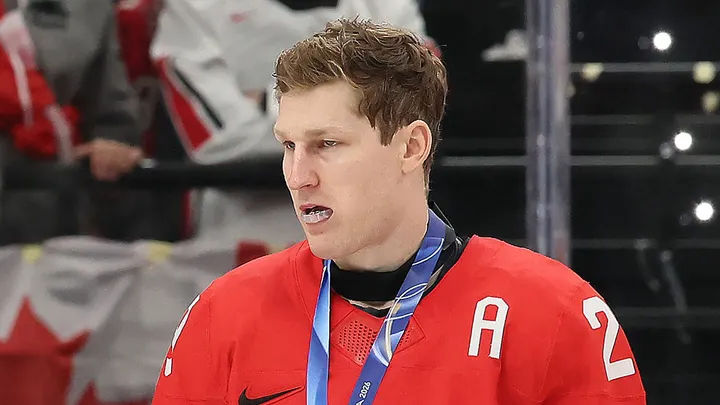
The statement struck a nerve. Was it an honest assessment rooted in performance metrics and game flow? Or was it an emotional reaction that undermined the essence of competition, where the final score is the only measure that truly matters? The controversy goes beyond one athlete’s frustration. It opens a broader debate about how we define superiority in sports: by statistics and style, or by results and resilience.
The Case for Canada: Dominance Beyond the Scoreboard
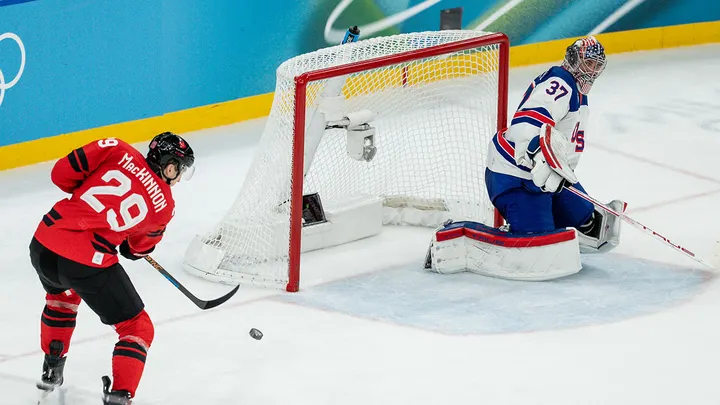
Supporters of MacKinnon’s perspective point first to the numbers. Over the course of the game, Canada outshot the United States by a significant margin. They controlled possession for extended stretches and generated more high-quality scoring opportunities. By traditional analytics—shots on goal, offensive zone time, and puck movement efficiency—Canada appeared to dictate the tempo.
In modern hockey analysis, advanced metrics often paint a more nuanced picture than the scoreboard alone. Expected goals (xG), scoring chances, and shot quality are commonly used to assess which team truly carried the play. From that angle, Canada’s performance may well have justified the claim that they were the stronger side overall.
Additionally, momentum throughout much of the game seemed to favor Canada. They forced turnovers, maintained pressure, and repeatedly tested the American defense. If hockey were judged like figure skating—by evaluating control, artistry, and sustained execution—Canada might have walked away with gold.
But hockey is not a judged sport. It is decided by goals.
Still, defenders of MacKinnon argue that acknowledging superior play despite defeat is not inherently disrespectful. Athletes frequently analyze games in terms of performance quality. A team can dominate and still lose due to a hot opposing goaltender or a single mistake. In such cases, saying “we were the better team” can reflect a belief in process over outcome—an emphasis on playing the right way, even if the result did not follow.
The American Response: Results Define Greatness
Critics, however, see the situation differently. Team USA did what champions do: they capitalized on their opportunities and executed when it mattered most. In overtime, under the highest pressure imaginable, they delivered the decisive goal. That, in the most fundamental sense, defines superiority in competitive sport.
A game is not a statistical exhibition. It is a contest with a clear objective: score more goals than your opponent. The United States achieved that objective. Therefore, by the core logic of sport, they were the better team on that day.
Moreover, the American victory was not merely luck. Their defensive structure held firm under relentless pressure. Their goaltender delivered an extraordinary performance, making save after save to keep the game within reach. Clutch performances—particularly from goaltenders—are not accidents. They are part of the team’s identity and preparation. To dismiss such resilience as mere fortune diminishes a critical dimension of hockey excellence.
The overtime goal symbolized composure and opportunism. While Canada struggled to convert their chances, the Americans seized theirs. Efficiency, not volume, ultimately determines outcomes.
In this light, MacKinnon’s comments risk sounding like a refusal to fully acknowledge that reality. For some fans and commentators, suggesting moral or stylistic superiority after a loss borders on poor sportsmanship. The gold medal ceremony leaves no ambiguity. There is one champion.
The Emotional Context of Defeat
It is important, however, to consider the human element. Athletes invest years—often decades—into reaching the Olympic stage. The final buzzer of a gold medal game can represent the culmination of lifelong dreams. In the immediate aftermath of such a loss, emotions run high.
MacKinnon’s remarks may have been less a calculated critique of Team USA and more an expression of disbelief and frustration. From his vantage point on the ice, Canada may have felt dominant. When a team outshoots and out-chances an opponent yet loses, the result can feel unjust.
Sports are filled with similar narratives. In soccer, a team can hold 70% possession and still lose 1–0 on a counterattack. In basketball, a team can shoot better overall but fall short because of turnovers. These paradoxes fuel debates about fairness versus finality.
Athletes often speak about “process.” Coaches emphasize that if a team plays the right way, wins will follow over time. In that philosophical framework, one game does not necessarily invalidate the belief that you were superior in structure and execution.
The question is whether such reasoning belongs in the immediate aftermath of an Olympic final.
The Spirit of the Olympics
The Olympics carry symbolic weight beyond ordinary competition. They celebrate excellence, unity, and respect among nations. Public statements by athletes, especially in high-profile moments, resonate globally.
Some observers argue that the Olympic spirit demands unequivocal respect for the victor. By hinting that Canada was better despite losing, MacKinnon may have unintentionally shifted focus away from American achievement.
On the other hand, the Olympic spirit also embraces authenticity. Athletes are not required to suppress honest assessments. Expressing belief in one’s team can be interpreted as pride rather than disrespect.
The line between confidence and bitterness is thin. Interpretation often depends on tone, timing, and audience perception.
The Psychology of “Better”
What does it mean to be “better” in a single game?
Is it about sustained dominance over 60 minutes? Is it about composure in critical moments? Or is it simply about the final tally?

From a purely logical standpoint, the scoreboard settles the argument. But from a psychological and analytical standpoint, performance evaluation is more complex.
A team might outplay its opponent nine times out of ten but lose the tenth due to variance. In that isolated instance, was the loser inferior—or merely unlucky?
Hockey, with its fast pace and reliance on goaltending, is particularly susceptible to variance. A single bounce can determine destiny. This unpredictability is part of what makes the sport thrilling, but it also complicates declarations of superiority.
MacKinnon’s comment taps into this complexity. He may have been suggesting that dominance in play does not always align with victory.
Yet sports culture tends to reward outcomes, not hypotheticals.
Legacy and Rivalry
The Canada–USA hockey rivalry is one of the most intense in international sport. Every meeting carries historical weight. For Canada, a nation that prides itself on hockey excellence, losing Olympic gold to its closest rival is especially painful.
For the United States, the victory symbolizes growth and parity on the global stage. It echoes historic moments that reshaped perceptions of hockey power dynamics.
In this context, words matter even more. Each side is eager to frame the narrative. Americans celebrate a breakthrough triumph. Canadians analyze what went wrong.
MacKinnon’s remarks became part of that narrative battle.
A Balanced View
Ultimately, both interpretations hold validity.
Canada likely did control large portions of the game. Their offensive pressure and statistical edge suggest a high level of performance. From an analytical perspective, one could argue they “deserved” more.
But sport does not award medals for deserving. It rewards execution.
The United States executed when it mattered most. They defended, they survived, and they scored in overtime. That is the essence of championship performance.
Perhaps the most accurate conclusion is this: Canada may have been the more dominant team over extended stretches, but Team USA was the more decisive team in the moments that defined the game.
And in championship sport, decisiveness defines greatness.
Conclusion: Beyond One Quote
Nathan MacKinnon’s comment sparked controversy because it touched on a universal tension in competition: performance versus result. Was Canada the better team? It depends on how one defines “better.”
If better means controlling play and generating opportunities, Canada has a compelling case.
If better means winning the game under the brightest lights, the answer is unequivocal: Team USA earned the gold.
In the end, perhaps the debate itself underscores why we love sports. They are not always fair. They are not always aligned with statistical logic. They are decided by moments—fleeting, unforgiving moments that crown one side and break the other.
MacKinnon’s words may fade with time. The gold medal will not.
Leave a Reply