
There are artists who define moments.
And then there are artists who define eras.
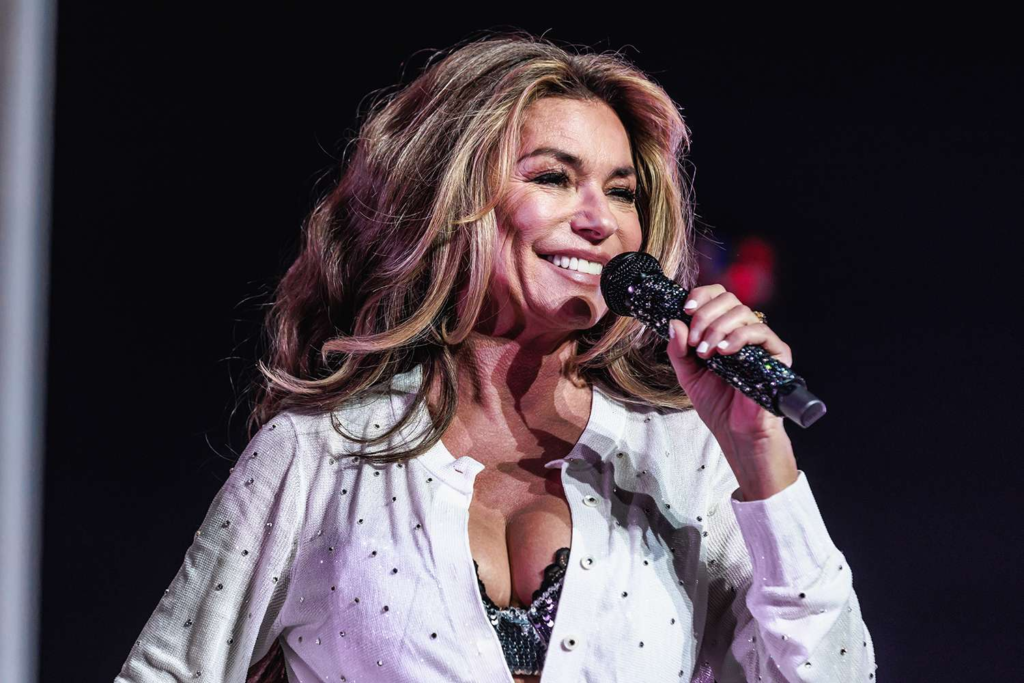
For decades, Shania Twain has belonged firmly to the latter—not simply as a performer, but as a transformative force who reshaped what country music could be, where it could go, and who it could reach. Her voice didn’t just fill arenas; it crossed borders, broke expectations, and gave millions of people a reason to sing louder, stand taller, and feel seen.
So when the idea surfaces—even as a quiet possibility—that she might one day step onto a stage for the final time, the reaction isn’t just anticipation.
It’s reflection.
Because a moment like that wouldn’t feel like a concert.
It would feel like the closing of a chapter far bigger than music.

The Sound That Changed Everything
Before Shania Twain, country music largely lived within its own world—rich in storytelling, deeply rooted in tradition, but often confined by genre expectations. Twain didn’t reject those roots. She expanded them.
With a fearless blend of country, pop, and rock, she created a sound that felt both familiar and revolutionary. It welcomed new listeners without alienating longtime fans. It was bold without losing its emotional core.
When Come On Over arrived, it didn’t just perform well—it exploded. The album went on to become one of the best-selling records in music history, turning Twain into a global icon and proving that country music could dominate international charts.
But numbers alone don’t tell the full story.
What mattered more was how those songs lived in people’s lives. “You’re Still the One” became a wedding anthem. “Man! I Feel Like a Woman!” became a declaration of confidence. “From This Moment On” became a soundtrack to love stories across cultures.
These weren’t just songs.
They were moments people carried with them.
More Than Music: A Voice of Confidence
Part of what made Twain’s impact so lasting was her presence—not just as a singer, but as a symbol.
At a time when female artists in country music often faced limitations in how they could present themselves, Twain rewrote the narrative. She was glamorous, outspoken, and unapologetically herself. She embraced femininity as strength, not constraint.
For many fans, especially women, that mattered.
She wasn’t just singing about confidence.
She embodied it.
And in doing so, she created space for others to do the same.
The Silence Between the Songs
But every era has its challenges.
At the peak of her career, Twain faced a battle that few outside her inner circle could fully understand. A vocal disorder threatened the very thing that defined her. Singing—once effortless—became uncertain.
For an artist whose connection to the world was built through her voice, that silence carried weight.
Years passed without new music. Public appearances became rare. Questions lingered.
Was this the end?
For many artists, it might have been.
But Shania Twain’s story was never going to follow a predictable path.
A Return Rooted in Resilience
When Shania Twain returned, it wasn’t framed as a perfect comeback. There was no attempt to pretend nothing had changed.
Her voice was different—more textured, shaped by everything she had endured.
And that honesty became part of the performance.
Fans didn’t come back expecting perfection. They came back for connection.
And what they found was something deeper than before.
Each note carried history. Each performance felt earned. Each appearance was a reminder that resilience can be just as powerful as talent.
The Meaning of “One Last Stage”
The idea of a “final stage” carries a kind of quiet gravity.
It doesn’t have to be officially announced. It doesn’t need a countdown. Sometimes, it exists simply as a possibility—an awareness that no artist performs forever.
But for someone like Twain, that idea feels different.
Because her career was never just about the present moment. It was about continuity—about how songs released decades ago still resonate today, how new listeners continue to discover her music, how her influence lives on through others.
A final performance, whenever it comes, wouldn’t mark the end of that influence.
It would simply mark the end of a particular kind of presence.
The physical, immediate, electric connection between artist and audience in a shared space.
The Audience That Grew With Her
One of the most remarkable aspects of Twain’s career is the way her audience has evolved alongside her.
Fans who first heard her in the 90s are now sharing her music with their children. Concert crowds often span generations, with parents and teenagers singing the same lyrics, each for their own reasons.
That kind of longevity is rare.
It speaks to something deeper than trend or timing.
It speaks to authenticity.
Because while the industry around her changed—styles shifting, technologies evolving, tastes transforming—Twain remained recognizable.
Not static, but consistent in spirit.
A Legacy That Refuses to Fade
If there is one thing history has shown, it is that true cultural impact doesn’t disappear when the spotlight dims.
It lingers.
It reappears in unexpected places—in covers, in playlists, in moments where someone hears a familiar melody and is instantly transported back in time.
Shania Twain’s legacy is built on those moments.
On the road trips where her songs played through the speakers.
On the weddings where couples chose her lyrics to express what they couldn’t say themselves.
On the quiet nights where her voice offered comfort.
That kind of presence doesn’t end.
It evolves.
Beyond the Final Bow
When the day eventually comes that Shania Twain steps off the stage for the last time, it won’t be defined by silence.
Because the music will still be there.
The recordings. The memories. The impact.
And perhaps most importantly, the feeling.
That sense of empowerment. Of joy. Of connection.
Those things don’t fade when the lights go down.
They stay.
Conclusion: A Heart That Keeps Singing
There is something poetic about the idea of a final performance—not as an ending, but as a moment of recognition.
A pause to look back. To appreciate. To understand the full weight of what has been created.
For Shania Twain, that weight is immense.
Not measured just in sales or awards, but in lives touched, in confidence inspired, in boundaries broken.
She didn’t just define an era.
She helped shape what came after it.
And whether or not there is ever a clearly defined “last stage,” one truth remains:
Her voice—changed, challenged, but never silenced—continues to echo.
Because some artists don’t stop singing when the music ends.
They keep singing in the hearts of those who listened.