I stared at her. “You were the one telling him to break down my door.” Arthur stepped beside me, calm as ever. “And the security cameras recorded every second.”
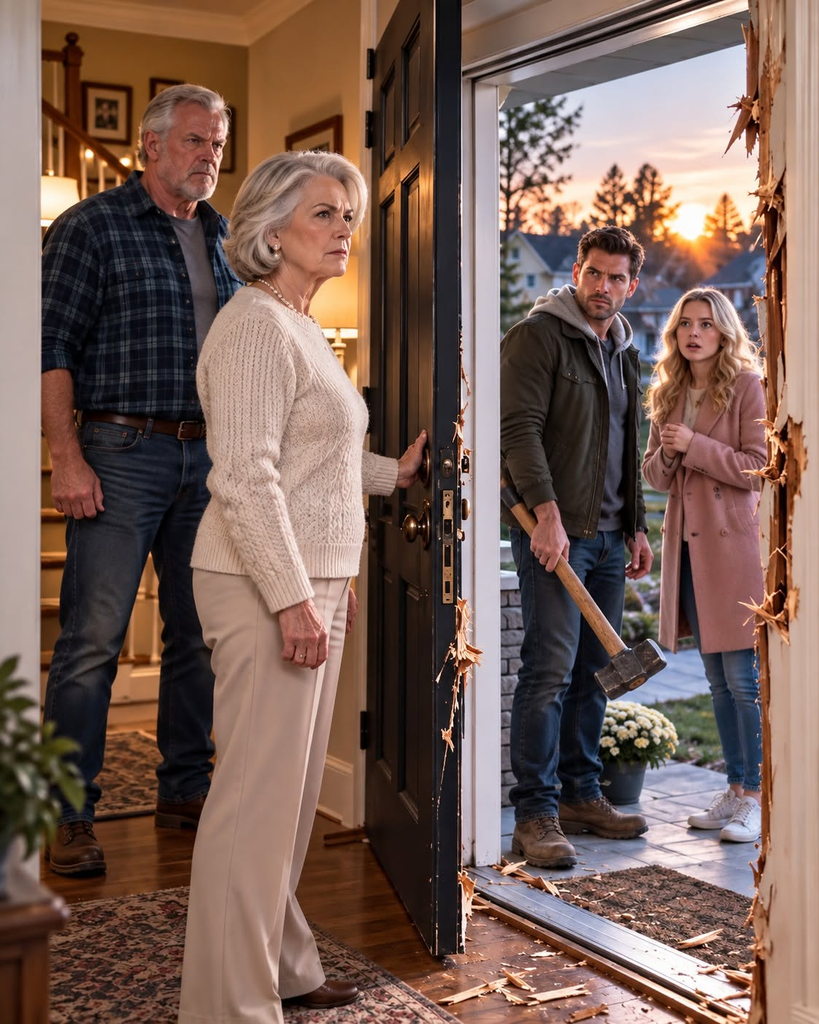
David lowered the hammer. “Mom, what is going on?” I looked past him toward their luggage stacked beside the driveway. “What’s going on is that you no longer live here.”
Sarah laughed sharply. “You can’t just throw us out.” “Actually,” Arthur said, “Lisa can. Your belongings were packed, inventoried, photographed, and moved into paid storage. You’ve also been given written notice.”
David looked at me as though I had betrayed him. “You went through our things?” “No,” I said. “Professionals did. Which turned out to be useful.”
That wiped the anger from his face.
I went back inside and returned with a thick envelope. “Would you like to explain why I found brochures for assisted living facilities? Or the printed power-of-attorney forms with yellow tabs showing where I was supposed to sign?”
Sarah’s expression changed. “Those were just options.” “Options for whom?” I asked. “Certainly not for me.”
David glanced at his wife. “Mom, we were worried about you.” I almost smiled. “Were you worried when you discussed getting your name onto my deed before moving me out?”
He froze.
Arthur folded his arms. “Lisa heard the conversation.” Silence settled over the porch.
Then I handed David one final document. “And there’s something else.”
He unfolded it slowly.
It was a copy of a home-equity application.
My address was listed as collateral.
David’s name appeared as applicant.
And beneath it was a signature that looked remarkably like mine.
Except I had never signed anything.
Sarah stepped backward.
David stared at the page. “I didn’t submit this.”
I studied his face carefully and, for the first time that morning, believed he might actually be telling the truth.
Arthur noticed too.
He reached into the envelope and removed the final page.
Then he looked directly at Sarah.
“Interesting,” he said. “Because the application was uploaded from an email account registered in your name.”
Sarah’s face collapsed.
And David slowly turned toward his wife.
PART 3
David slowly turned toward his wife.
“Sarah?”
She didn’t answer.
She just stared at the document in Arthur’s hand.
Then she shook her head.
“No. That’s not what you think.”
David looked back at the application.
“My name is on this.”
“So?” Sarah snapped. “We were trying to figure out what the house was worth.”
“My house?” I asked.
She looked at me.
“Our future house.”
Those four words changed everything.
David’s face hardened.
“Sarah, what did you do?”
She crossed her arms.
“I was trying to protect us.”
“By forging Mom’s signature?”
“I didn’t forge anything!”
Arthur calmly pointed to the signature.
“Then you won’t mind explaining why it doesn’t match Lisa’s signature on the documents she actually signed.”
Sarah went silent.
David looked sick.
I watched him carefully.
For three months, I had wondered whether my son was part of the plan.
Now I finally knew.
He had been involved.
But perhaps he hadn’t known the entire plan.
“David,” I said quietly, “did you know about the home-equity application?”
“No.”
“Did you know Sarah was planning to put me into assisted living?”
He hesitated.
That hesitation hurt more than any answer.
“I knew she was looking into facilities,” he finally admitted.
My chest tightened.
“So you knew.”
“I didn’t think she was serious.”
Sarah suddenly shouted, “Because you were too scared to do anything!”
David spun around.
“What the hell is that supposed to mean?”
“You said yourself that your mother was never going to give us the house voluntarily!”
“I said eventually!”
“You said we needed to do something!”
“I never said forge her signature!”
Sarah went completely still.
Arthur and I exchanged a look.
There it was.
The truth.
Not the whole truth.
But enough.
I stepped back.
“David, I raised you in this house.”
He looked at the floor.
“After your father died, this house was the only thing I could give you that would never disappear.”
“I know, Mom.”
“No. You don’t.”
My voice broke.
“You know the walls. You know the address. You know the value of the property.”
I pointed toward the hallway.
“But you forgot what happened here.”
David looked up.
“Your father taught you how to ride a bicycle in that hallway.”
He said nothing.
“You took your first steps in that living room.”
His eyes became glassy.
“You sat beside me on those stairs the night we got the phone call that your father was gone.”
David swallowed hard.
“And now you stood outside that same house with a sledgehammer.”
He couldn’t look at me anymore.
Sarah rolled her eyes.
“Oh, come on. We’re not going to turn this into some sentimental—”
“Enough.”
David’s voice was quiet.
But for the first time, he wasn’t defending her.
He was defending me.
Sarah stared at him.
“You’re taking her side?”
David shook his head.
“I’m trying to understand what you did.”
“What I did?”
She laughed.
“You think your mother would have given you this house if you waited long enough?”
David stared at her.
“She didn’t have to.”
Sarah blinked.
“What?”
“She didn’t have to give us anything.”
That was when Sarah realized she had lost him.
Arthur had already contacted an attorney before David ever arrived that morning.
We didn’t confront them with threats.
We didn’t need to.
We had photographs.
Security footage.
Copies of the documents.
The assisted-living brochures.
The power-of-attorney forms.
The home-equity application.
And records showing where the application had been uploaded.
Everything was documented.
Every conversation that mattered had been preserved legally.
Sarah suddenly became very quiet.
She asked if she could speak to me privately.
I said no.
She asked David.
He refused.
Then she started crying.
Not the kind of crying I remembered from family dinners.
This was different.
Desperate.
“I made a mistake,” she whispered.
I looked at her.
“No.”
She wiped her eyes.
“I made several mistakes.”
I shook my head.
“You made a plan.”
She said nothing.
“And you made that plan inside my home, while sleeping under my roof, eating food I bought, using electricity I paid for, and calling yourself family.”
Her face crumpled.
“You’re going to destroy our marriage.”
I looked at David.
“No, Sarah.”
Then I said the sentence I had been waiting three months to say.
“You did that yourself.”
PART 4
The next few weeks were complicated.
There were lawyers.
Police reports.
Bank investigations.
Phone calls.
Statements.
Questions I never imagined answering about my own son.
The home-equity application was eventually withdrawn before any money was released.
The bank opened an investigation into the forged signature.
Sarah initially denied everything.
Then she changed her story.
Then she blamed David.
Then she claimed she had only been “researching possibilities.”
But the evidence was too clear.
The security footage showed her removing documents from my office.
The computer records showed the application being uploaded.
The metadata on several files showed they had been created on her laptop.
And the most damaging piece of evidence came from a text message she had sent to a friend two weeks before the sledgehammer incident.
She wrote:
“Once Lisa is placed somewhere, we can finally refinance the house.”
That sentence ended the argument.
There was no misunderstanding anymore.
No confusion.
No innocent explanation.
There had been a plan.
And I had nearly become a prisoner inside my own home.
Sarah moved out of state to stay with her sister.
David stayed in a small apartment by himself.
For almost six months, we barely spoke.
Then one afternoon, my doorbell rang.
I looked through the camera.
David was standing outside.
Alone.
No sledgehammer.
No Sarah.
Just my son.
He was holding a cardboard box.
I opened the door but didn’t invite him inside.
“Hi, Mom.”
“Hi.”
He looked older.
Not physically.
Just tired.
“I brought these back.”
He opened the box.
Inside were photographs.
My husband’s old watch.
A few childhood drawings.
And a small wooden toy car.
I recognized it immediately.
David had played with it when he was five.
“You kept this?”
“I couldn’t throw it away.”
He looked down.
“I couldn’t throw any of it away.”
We stood there in silence.
Finally he said:
“I’m sorry.”
I didn’t answer.
“I know sorry doesn’t fix anything.”
“No.”
“I know I can’t ask you to trust me.”
“No.”
He nodded.
“I deserved that.”
Then he took a breath.
“I should have stopped her the first time she talked about the house.”
I looked at him.
“You should have stopped her before she ever talked about me.”
His eyes filled with tears.
“I know.”
He wiped them away.
“I was greedy.”
That word surprised me.
Not because it was harsh.
Because it was honest.
“I kept telling myself I wasn’t doing anything wrong because it was going to be my house someday anyway.”
He looked toward the living room.
“But I started thinking about what I could have instead of what I was losing.”
I didn’t say anything.
He continued.
“You weren’t losing your house, Mom.”
He looked at me.
“You were losing your son.”
I felt my throat tighten.
For a moment, I wanted to open the door wider.
I wanted to hug him.
I wanted everything to go back to before the laundry basket.
Before the blender.
Before the missing keys.
Before the whispered conversation.
Before the sledgehammer.
But some things don’t go backward.
They have to be rebuilt.
Brick by brick.
Day by day.
So I simply said:
“Thank you for finally telling me the truth.”
He nodded.
“Can I come back someday?”
I looked at him.
“Someday.”
That was all I could give him.
And for the first time, he didn’t argue.
He nodded.
Then walked away.
PART 5
A year passed.
I kept the house.
I kept my husband’s oak console table.
I bought another espresso machine.
And I installed a much better security system.
Arthur joked that I now had enough cameras to monitor the entire neighborhood.
I told him:
“After what happened, I like knowing who’s knocking.”
He laughed.
Life became quiet again.
The kind of quiet I had once taken for granted.
Then, one Saturday morning, I heard a knock.
I checked the camera.
David.
This time he wasn’t alone.
He was standing beside a little girl.
She looked about six.
I opened the door.
David smiled nervously.
“Mom… this is Emma.”
The little girl looked up at me.
“Are you Grandma?”
I smiled.
“Yes.”
She held out a drawing.
“I made this for you.”
I took it.
It was a picture of a house.
Four people stood outside.
A little girl.
A man.
A woman.
And an older woman.
Above them was a bright yellow sun.
At the top, in crooked letters, she had written:
HOME
I looked at David.
He didn’t say anything.
He didn’t ask to move back in.
He didn’t ask about the deed.
He didn’t ask about money.
He just stood there.
Waiting.
I opened the door wider.
“Come in.”
His eyes filled with tears.
“Are you sure?”
I nodded.
“But there are rules.”
He smiled.
“I figured.”
“Rule number one: nobody rearranges my kitchen.”
He laughed.
“Fair.”
“Rule number two: nobody touches your grandfather’s furniture.”
“Absolutely.”
“And rule number three…”
I looked directly at him.
He waited.
“You never mistake being my son for being entitled to my life.”
His smile disappeared.
Then he nodded.
“I won’t.”
Emma tugged on my sweater.
“Grandma?”
“Yes?”
“Can I see your coffee machine?”
I laughed.
“Now you’re asking the important questions.”
David smiled.
And for the first time in a very long time…
I let my son back into my house.
Not because he was entitled to it.
Not because he was my only son.
Not because I was afraid of being alone.
I let him in because he finally understood the difference between being given a home and taking one.
And that Sunday morning with the sledgehammer?
I never forgot it.
But I also never let it define the rest of my life.
Because sometimes the strongest thing a mother can do…
is close the door.
And sometimes, after someone finally learns why it was closed…
you can choose whether to open it again.