In the modern media landscape, images travel faster than explanations.
A single photograph—captured in a split second—can circle the globe within minutes, interpreted, reinterpreted, and debated by millions. Sometimes, those images pass quietly through the news cycle.
Other times, they become the story itself.
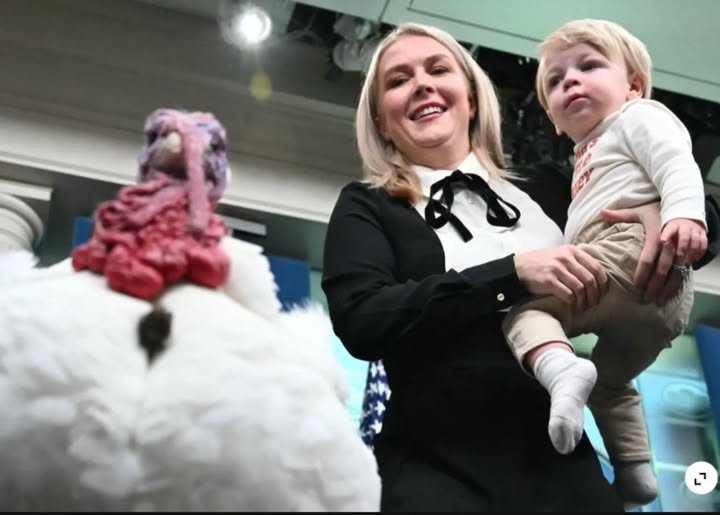
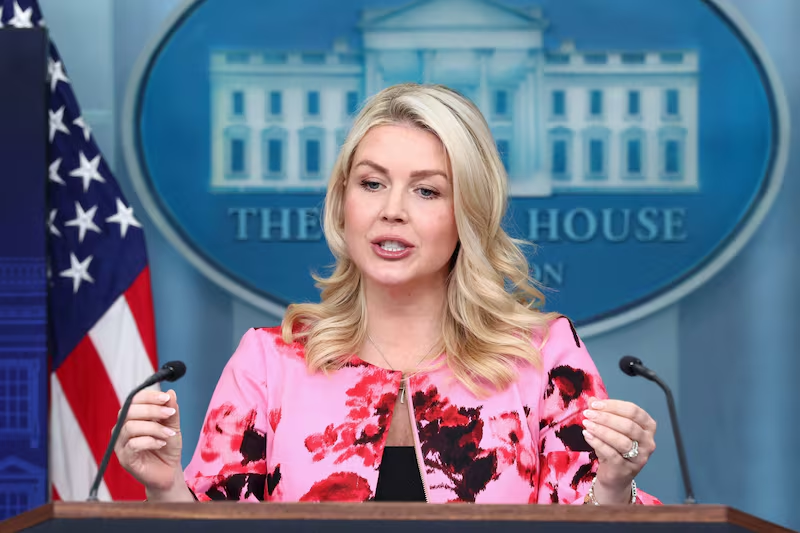
That is exactly what happened when Karoline Leavitt, press secretary to Donald Trump, found herself at the center of unexpected attention—not because of a policy statement or press briefing, but because of a single, widely circulated photo.
A photo that, ironically, might have gone unnoticed—if not for what happened next.
The Moment Captured
The image itself was, on the surface, unremarkable.
Taken during what appeared to be a routine public event, it showed Leavitt standing near a turkey—more specifically, a gobbler—likely part of a ceremonial or seasonal appearance.
There was no controversy in the setting.
No political statement embedded in the scene.
Just a moment—frozen in time—where timing, expression, and angle combined in a way that some viewers later described as “unflattering.”
In another era, the image might have passed without comment.
But in today’s environment, where every detail is scrutinized, it didn’t take long for the photo to begin circulating online.
The Internet Notices
At first, the attention was minimal.
A few shares.
A handful of comments.
Some light humor.
The kind of low-level engagement that most public figures experience regularly.
But then, something shifted.
The image began to gain traction—not because of what it showed, but because of how it was perceived.
Users began reposting it with captions.
Memes started to appear.
Discussions emerged about media portrayal and public image.
Still, it was far from a major story.
Until an attempt was made to control it.
The Complaint That Changed Everything
According to reports, concerns were raised from within the White House regarding the photo.
The issue was not its content—but its presentation.
It was described as “unflattering.”
And in a media environment where image matters as much as message, that concern was taken seriously.
Shortly afterward, the photograph was reportedly flagged—and then removed—from major image distribution platforms, including international agencies.
From a technical standpoint, this was not unprecedented.
Organizations occasionally request the removal of images for various reasons—accuracy, context, or editorial standards.
But in this case, the removal itself became the trigger.
Because the moment something disappears in the digital age…
People start asking why.
The Streisand Effect in Action
What happened next followed a pattern that media analysts have seen before.
Often referred to as the “Streisand Effect,” it describes a phenomenon where attempts to suppress information actually lead to increased attention.
In this case, the effort to remove the image did not make it disappear.
It made it more visible.
Users began searching for it.
Archived versions resurfaced.
Screenshots circulated even more widely than the original.
What had been a minor moment became a trending topic.
Not because of the image itself—but because of the reaction to it.
From Photo to Symbol
As the story spread, the conversation evolved.
It was no longer just about a photograph of Karoline Leavitt and a turkey gobbler.
It became a broader discussion about:
- Media control
- Public image management
- The limits of influence in the digital age
For some observers, the incident highlighted how even small attempts at control can backfire in a decentralized information environment.
For others, it raised questions about fairness—whether public figures should have more say in how they are visually represented.
The Role of Donald Trump’s Media Strategy
The situation also drew attention because of the broader communication style associated with Donald Trump and his team.
Trump has long been known for his focus on media narratives and public perception.
From branding to messaging, the emphasis on image—both literal and figurative—has been a defining feature of his political approach.
In that context, the response to the photo was seen by some as consistent with a broader strategy:
Control the narrative.
Shape the image.
Respond quickly.
But as this incident demonstrated, controlling the narrative is not always straightforward.
Especially when the audience is no longer passive.
Social Media as an Uncontrollable Force
One of the key factors in this story is the role of social media.
Unlike traditional media, where content flows through centralized channels, social platforms operate differently.
They are:
- Decentralized
- Fast-moving
- Driven by user engagement
Once an image enters that ecosystem, it becomes difficult—if not impossible—to fully contain.
Even if the original source is removed, copies remain.
And sometimes, those copies spread even further.
This creates a paradox:
The more you try to control something, the more attention it may receive.
Humor, Criticism, and Interpretation
As the image continued to circulate, reactions varied widely.
Some users treated it as lighthearted humor—a harmless moment amplified by internet culture.
Others used it as a point of criticism, arguing that the response to the photo revealed deeper concerns about image management.
Still others focused on the broader implications, discussing how public figures navigate visibility in an age where every moment can be captured and shared.
This range of reactions reflects the complexity of modern media consumption.
A single image can mean different things to different audiences.
The Human Side of Public Image
Amid the analysis and debate, it’s easy to forget the human element.
Public figures like Karoline Leavitt operate under constant visibility.
Every expression, every angle, every moment is subject to scrutiny.
And while image management is part of the role, it also comes with challenges.
Because perfection is not possible.
And attempts to achieve it can sometimes create the very attention they aim to avoid.
A Small Moment with Bigger Implications
What makes this story notable is not the image itself.
It is what the image became.
A case study in:
- How information spreads
- How attempts at control can backfire
- How digital audiences respond to perceived censorship
In many ways, it reflects a broader shift in media dynamics.
Power is no longer held solely by institutions.
It is shared—sometimes unpredictably—by the public.
Conclusion: The Image That Wouldn’t Disappear
In the end, the photo of Karoline Leavitt and a turkey gobbler is just that—a photo.
But the story surrounding it is something more.
It is a reminder that in today’s world:
- Visibility is constant
- Control is limited
- And attention can come from the most unexpected places
For Donald Trump’s press secretary, what might have been a fleeting moment became a widely discussed topic.
Not because of what was captured.
But because of what followed.
And in the digital age, sometimes the attempt to make something disappear…
Is exactly what ensures it will be seen.