
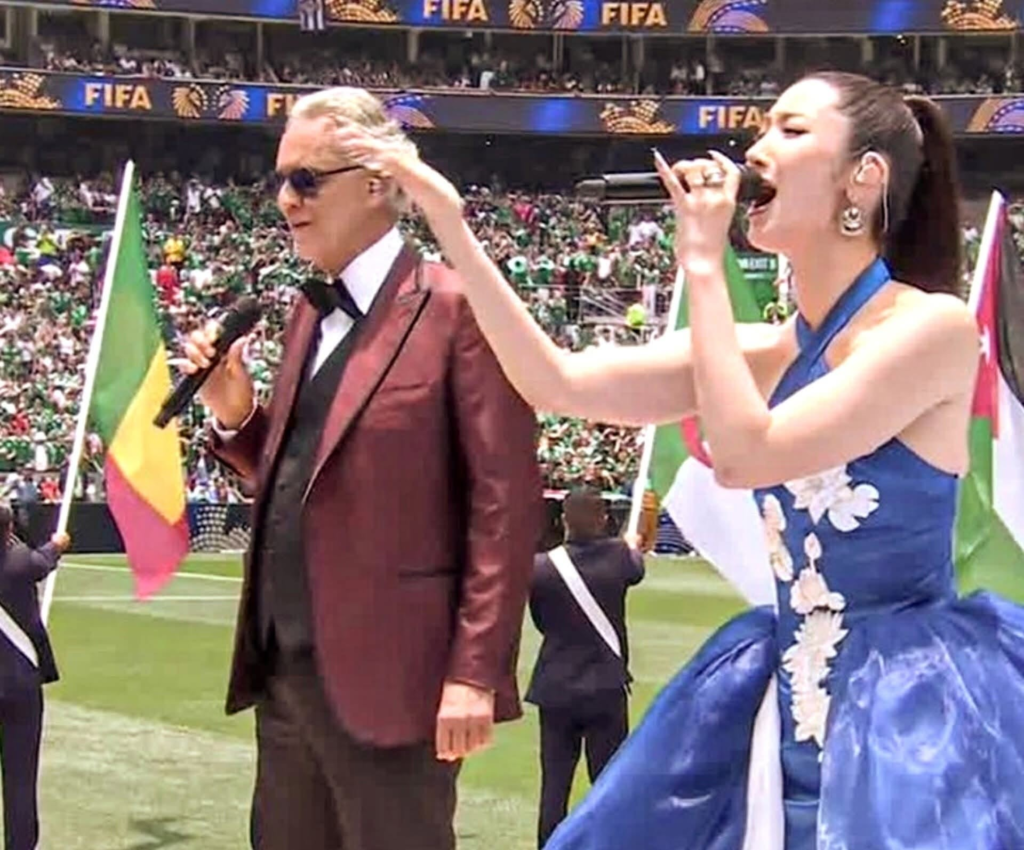
When millions of football fans around the globe tuned in to watch the opening ceremony of the FIFA World Cup 2026, one of the most unforgettable moments was the performance of renowned Italian tenor Andrea Bocelli. Standing before a worldwide audience, Bocelli lent his powerful voice to the tournament’s official anthem, captivating listeners with the emotion and elegance that have defined his extraordinary career.
Yet behind that remarkable voice lies a story that is even more extraordinary.
It is the story of a child whom doctors once advised should be aborted.
A Mother’s Courageous Decision
Andrea Bocelli was born on September 22, 1958, in the beautiful region of Tuscany, Italy. During her pregnancy, Bocelli’s mother experienced complications that caused concern among medical professionals.
According to Bocelli’s own account, doctors warned his mother that her unborn child would likely be born with a serious congenital condition. They feared he might face severe disabilities and recommended that she terminate the pregnancy.
Faced with uncertainty and fear, Bocelli’s mother made a different choice.
She refused.
Instead of ending the pregnancy, she decided to give her son a chance at life.
Years later, Bocelli would often refer to his mother’s decision as one of the greatest gifts he ever received. Her faith, courage, and determination not only changed his life but ultimately impacted millions of people around the world who would one day be moved by his music.
Had she followed the doctors’ advice, the world would never have known one of the greatest voices of modern times.
Born With a Serious Eye Condition
The doctors’ concerns were not entirely unfounded.
Bocelli was born with congenital glaucoma, a rare condition that damages the optic nerve and can severely affect vision. Throughout his childhood, he underwent numerous medical treatments and surgeries in an effort to preserve what little sight he had.
Despite these challenges, young Andrea refused to let his condition define him.
Like many children, he loved sports, enjoyed spending time with friends, and developed a deep passion for music. Even at an early age, he demonstrated exceptional musical talent and an unusual sensitivity to sound.
Family members and teachers recalled a cheerful, determined boy who approached life with optimism despite the obstacles before him.
No one could have predicted just how far that determination would take him.
The Accident That Changed Everything
At the age of twelve, Bocelli experienced a tragedy that would alter the course of his life forever.
While playing soccer with friends, he was struck in the head by a ball during a match. The impact caused a brain hemorrhage and further damaged his already fragile eyesight.
As a result, he lost his vision completely.
For many people, such a devastating event would have shattered dreams and ambitions. Losing one’s sight at such a young age can be overwhelming, bringing fear, uncertainty, and countless challenges.
But Andrea Bocelli refused to surrender to despair.
Instead, he found a new way to see the world.
Finding Light Through Music
Music had always been a part of Bocelli’s life.
He began studying piano at the age of six and later learned several other instruments, including the flute, saxophone, trumpet, guitar, and drums. After losing his sight, music became more than a passion—it became a lifeline.
Through melodies and harmonies, he discovered a way to express emotions, connect with others, and build a future.
He dedicated countless hours to practice, mastering classical works and developing the powerful vocal technique that would later become his trademark.
However, success did not come overnight.
Bocelli studied law and eventually earned a law degree. For a period of time, he worked as a lawyer while performing in piano bars and local venues during the evenings to support himself financially.
Few people watching him perform in small clubs could have imagined that he would one day become a global superstar.
The Breakthrough
Bocelli’s life changed dramatically in the early 1990s.
The Italian singer-songwriter Zucchero was searching for a vocalist to record a demo version of the song “Miserere.” Bocelli was chosen for the task.
The recording eventually reached legendary tenor Luciano Pavarotti.
Pavarotti was deeply impressed.
Recognizing Bocelli’s exceptional talent, he praised the young singer and encouraged his career. The endorsement from one of opera’s greatest icons opened doors that had previously seemed impossible to enter.
Soon afterward, Bocelli began attracting international attention.
His remarkable voice, blending classical precision with emotional warmth, resonated with audiences across cultures and languages.
Becoming a Global Phenomenon
Over the following decades, Andrea Bocelli became one of the most successful classical crossover artists in history.
His albums topped charts around the world. He performed in prestigious concert halls, opera houses, cathedrals, and stadiums. His music transcended national boundaries, touching people regardless of their background or beliefs.
Songs such as:
- Con te partirò
- Time to Say Goodbye
- The Prayer
became international classics.
His collaborations with artists from various musical genres expanded his reach even further, introducing opera and classical music to audiences who might never have explored the genre otherwise.
Today, Bocelli has sold tens of millions of records worldwide and remains one of the best-selling classical artists of all time.
What makes those achievements even more remarkable is that he accomplished them without ever seeing the audiences that applauded him.
A Symbol of Hope and Perseverance
Throughout his career, Bocelli has become much more than a singer.
He is widely regarded as a symbol of perseverance, resilience, and hope.
His story demonstrates that physical limitations do not determine a person’s value or potential. Instead, determination, talent, and courage often matter far more than circumstances.
Whenever Bocelli takes the stage, he reminds people that adversity does not have to define the future.
His life encourages others facing challenges—whether physical, emotional, or personal—to continue pursuing their dreams despite setbacks.
Millions have found inspiration not only in his music but also in the example he sets through his life.
A Full-Circle Moment at the World Cup
In 2026, at the age of 67, Bocelli once again stood before a global audience when he performed the official FIFA World Cup anthem.
The moment carried a profound sense of symbolism.
As a young boy, a soccer accident had contributed to the loss of his remaining eyesight.
Decades later, football once again became part of his story—but this time, not through tragedy.
Instead, it provided a stage on which he could share his gift with the world.
The sport that had once been associated with one of the darkest moments of his life became the setting for one of its brightest.
It was a powerful reminder that life often unfolds in unexpected ways.
A Story That Continues to Inspire
Andrea Bocelli’s journey is about far more than music.
It is a story of a mother’s courage, a child’s determination, and the extraordinary possibilities that can emerge even from the most difficult circumstances.
A baby whom doctors feared would face overwhelming challenges grew into one of the most beloved singers on Earth.
A boy who lost his sight found another way to illuminate the world.
And a man who was once told he might never live a normal life went on to inspire millions through his artistry, faith, and perseverance.
His story serves as a timeless reminder that no one can fully predict the value, potential, or future of a human life.
Sometimes, the people who face the greatest obstacles become the very individuals who leave the deepest impact on the world.
Andrea Bocelli is living proof of that truth.